Event
AIPE 2026 Recap: The Innovations and Insights That Defined Starweaver's AI in Professional Education Summit
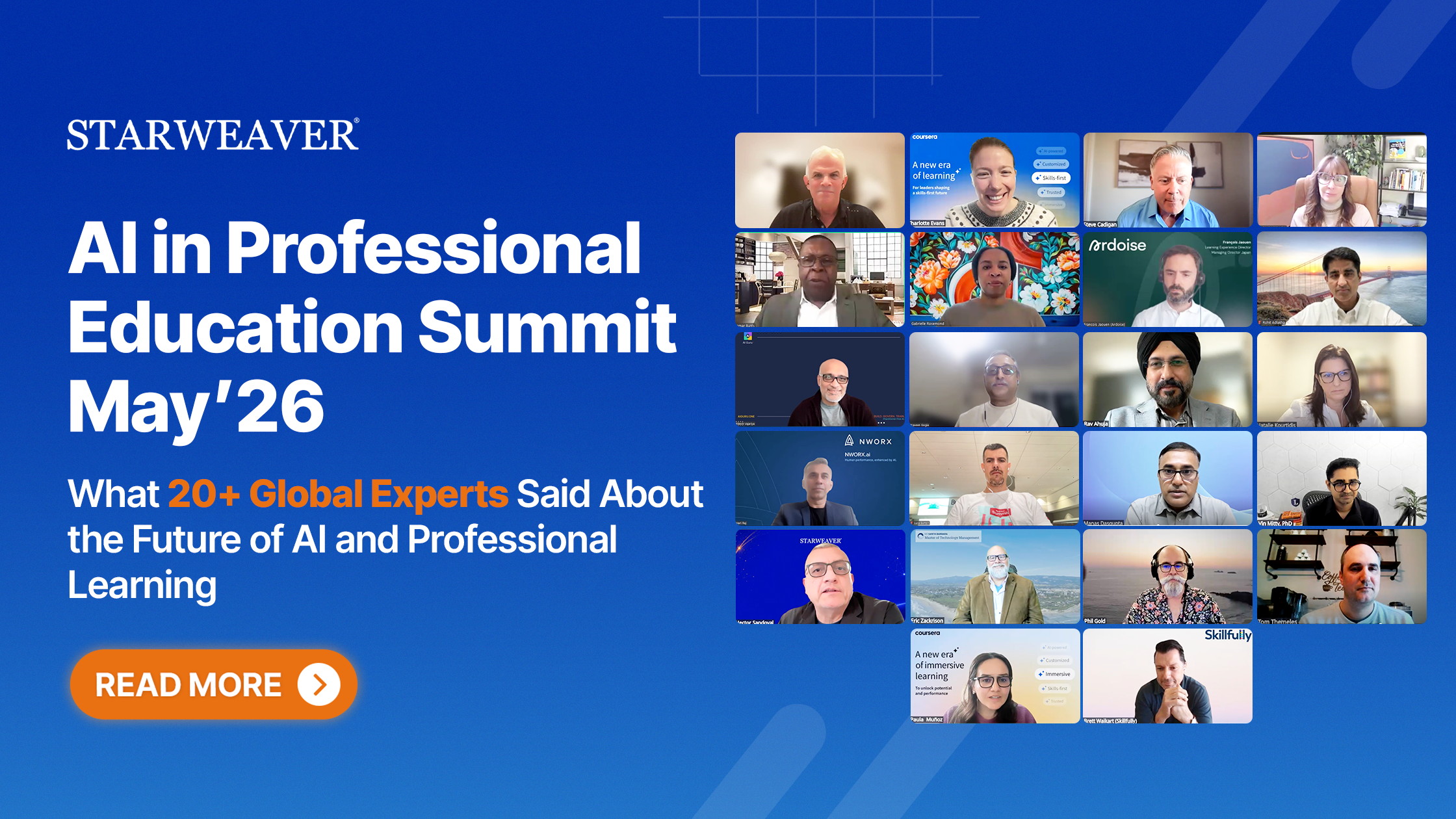
AIPE 2026 Recap: The Innovations and Insights That Defined Starweaver's AI in Professional Education Summit
On May 14, 2026, more than 1000+ professionals from 715 organizations gathered virtually to tackle one question:
What does AI actually mean for professional education, and what needs to happen now?
Hosted by Starweaver, the AI in Professional Education Summit brought together 20+ global speakers across six hours of keynotes, panel sessions, and live product demonstrations. The audience spanned higher education, enterprise learning, banking, technology, EdTech, and consulting. This is the full recap.
By the Numbers
1,015 confirmed registrations from 715 unique organizations
20+ global speakers across keynotes, panels, and product demos
28% of attendees were senior leaders including Founders, CEOs, VPs, and Directors
370 registrants from higher education and research institutions alone
Organizations represented included LinkedIn, Oracle, Cisco, Citi, BNP Paribas, Wells Fargo, Coursera, Pearson, Deloitte, IBM, Google, TCS, Wipro, Infosys, and 700+ more.
Opening Keynote: Charlotte Evans, Coursera for Business
Charlotte Evans | Director of Global Customer Advocacy, Coursera for Business
Opening Keynote | Charlotte Evans | Coursera for Business
The research Charlotte presented was direct. McKinsey data shows only 7% of organizations have moved to a fully scaled AI approach, and only 39% are starting to see meaningful financial returns. The problem is not access to tools. It is depth of integration. Most organizations are using AI to polish emails and shorten tasks, not to redesign workflows.
"By 2030, according to Gartner, 0% of work will be done by humans without AI. And McKinsey projects that 72% of work will be done in collaboration between people and AI. We are not preparing our workforces fast enough for either of those realities."
- Charlotte Evans, Director of Global Customer Advocacy, Coursera for Business
Session 1: Beyond One-Size-Fits-All: How AI is Building a Learning Experience of One
Speakers-
Paul Siegel, Founder, Starweaver | Moderator
Gabrielle Rosemond (TikTok),
LaMar Bunts (Former Dartmouth)
Francois Jaouen (Ardoise)
Rohit Adlakha (CXO and Board Advisor)
Catherine Mattice (Civility Partners)
Session 1 | Beyond One-Size-Fits-All | Full Panel
Gabrielle Rosemond challenged the assumption that short-form content means shallow learning. TikTok users spend the equivalent of full movies watching content every day. The issue is not attention span. Francois Jaouen brought the cross-cultural dimension that often gets missed: personalization is not just about role and skill. In Japan, receiving coaching can feel like a correction, not a development opportunity. In France, learners expect more structured delivery. AI personalization has to carry cultural context, not just job title data. Catherine Mattice landed the sharpest observation of the session: 80% of CEOs believe they have involved HR early enough in AI decisions. Only 20% of HR professionals agree. That disconnect is where most AI adoption programs fail before they start.
Session 2: The AI Agent That Onboards, Coaches and Upskills- Without A Human in the Loop
Speakers-
Hari Vijayakumar (NWORX AI)
Praveen Gogia (Technology and Strategy) | Moderator
Ritesh Vajariya (ex-AWS)
Luca Berton (AI Infrastructure)
Session 2 | The AI Agent That Onboards, Coaches and Upskills | Full Panel
The central question this panel tackled head-on: can AI genuinely onboard, coach, and upskill people without a human in the loop? Hari Vijayakumar argued that coaching is largely a black box already. Luca Berton introduced a framework that resonated strongly with the audience: the agent risk trifecta. Praveen Gogia offered a practitioner's view. He now runs most of his sales research through AI agents overnight.
Session 3: Context Is the New Curriculum- How to Engineer AI that Actually Understands Your Business
Speakers-
Rav Ahuja, Thought leader, Learning with AI
Vin Mitty, Phd, Senior Director of Data Science & AI, PPLSI
Natalie Kourtidis, CEO, EdStrategy
Manas Dasgupta, CTO, Starweaver | Moderator
Session 3 | Context Is the New Curriculum | Full Panel
Rav Ahuja, who has helped build content programs reaching 4.5 million students on Coursera, framed the session around a deceptively simple idea: context is what makes AI useful rather than generic. Vin Mitty brought a data science practitioner's honesty to the room. Getting an AI tool to 75 to 80% accuracy is straightforward. Getting to 95 to 98% requires semantic modeling, defined business logic, and rigorous testing frameworks. Natalie Kourtidis pushed the discussion toward organizational structure: she sees the need for a dedicated AI office in institutions whose sole role is to break down departmental silos and ensure that governance frameworks.
Closing Keynote: Steve Cadigan, First Chief HR Officer of LinkedIn
Steve Cadigan | First Chief HR Officer, LinkedIn | Author, Workquake
Closing Keynote | Steve Cadigan | First CHRO, LinkedIn
Steve Cadigan opened with a line that reframed the entire summit: the Chief Learning Officer of Unilever, one of the most progressive talent organizations in the world, was recently asked what his team is focused on. The answer: eliminating distraction. Not a black belt leadership program. Not an AI certification. Eliminating distraction. That, Steve said, is the environment every L&D professional is operating in right now.
"AI is the biggest leadership challenge of our lifetime. But let us not make the mistake of believing this is a technical challenge. It is not. It is a culture challenge disguised as a technology challenge."
- Steve Cadigan, LinkedIn's First CHRO
McKinsey's research, which Steve cited, found 88% of organizations say they are using AI, but only 6% are seeing significant profit increases. The companies on the right side of that gap are specifically the ones augmenting people rather than replacing them.
Steve made the business case for speed to skill with a sharp data point: looking at the five most successful companies by market cap growth over the last five years (Nvidia, Microsoft, Google, Broadcom, Apple), the competitive advantage is not their long-tenured veterans. It is their ability to bring new people in with new ideas and make them productive fast. In a world where average employee tenure is now 2.5 years globally, the organizations that develop people fastest win.
Session 4: From Months to Minutes- How AI is Rewriting the Rules of Content Creation
Speakers-
Tom Themeles, Educator and Course Developer
Phil Gold, Sr Professional & Communications Manager
Eric Zackrison, PhD, Educator, Consultant, Speaker & Trainer
Hector Sandoval, Head of Business Strategy & Organizational Excellence, Starweaver | Moderator
Session 4 | From Months to Minutes | Full Panel
Tom Themeles opened with an observation the panel quickly validated: something fundamental shifted in AI capabilities in the last six months. Phil Gold, drawing on two decades of L&D experience including his time at Nike, gave the production reality directly. Eric Zackrison pushed back on pure speed framing: organizations are treating AI adoption as a technology problem when it is fundamentally a people problem.
Hector Sandoval grounded the discussion in Starweaver's own production experience: 60+ new courses per month, 350,000+ courses live across 18 of the 20 largest professional education platforms, built by combining an AI-accelerated production pipeline with a 400+ strong global network of subject-matter experts. The message from the panel: AI does not replace the expert. It makes the expert exponentially more productive.
Session 5: Product Moment - Four Live Tool Demonstrations
The afternoon product demonstration segment did what most AI conferences avoid: working platforms, live, in front of a global audience. No concept decks. No slideware. Four tools built specifically for AI-powered professional education, each demonstrating a different piece of the infrastructure the future of learning requires.
Ardoise.ai: AI as Assessor, Trainer, Mentor, and Coach
Francois Jaouen | Learning Experience Director and Managing Director Japan, Ardoise.ai
Product Demo | Francois Jaouen | Ardoise.ai
Francois demonstrated a Give Effective Feedback course where AI plays four distinct roles: pre-assessment to calibrate difficulty, instruction through contextual scenarios, guided exploration, and a full roleplay where an AI avatar named Priya pushes back, deflects, and challenges the learner in real time. The post-roleplay evaluation scored the interaction across five dimensions with sub-criteria, verbatim transcript analysis, and blind spots the learner had not addressed at all. Content is tailored to each learner's actual role and organization. Existing SCORM content can be augmented rather than replaced.
Skillful.ly: Simulating Real Work to Measure Real Readiness
Brett Waikart | CEO and Co-founder, Skillful.ly
Product Demo | Brett Waikart | Skillful.ly
Brett's core argument: employers no longer care whether someone knows something. They care whether someone can apply it. Skillfully builds dynamic simulations that mirror the actual look and feel of professional work, from email inbox prioritization to live Zoom call roleplays with AI-played customers. The platform scores every interaction against a proficiency rubric for durable skills including communication, critical reasoning, and attention to detail. Used by Fortune 50 and Fortune 100 companies as a persistent coaching layer, it delivers personalized, bite-sized feedback in the flow of work rather than in a scheduled classroom.
Coursera: Coach, Dialogs, and AI Course Creation
Paula Munoz | Solutions Consultant LATAM, Coursera
Product Demo | Paula Munoz | Coursera
Paula demonstrated three AI features now embedded in the Coursera platform. Coach is a conversational AI tutor trained on every course's full content that helps learners through concepts, practice questions, and career application in real time. Learners engaging with Coach pass assessments at measurably higher first-attempt rates. Dialogs extend this into Socratic-method practice with scenario-based questions and voice interaction. The AI course creator allows enterprise customers to generate complete, structured courses from prompts in minutes without instructional design expertise.
Journeybuilder: A Voice-Forward, Hyper-Personalized Learning Path Engine
Paul Siegel | Founder, Starweaver
Product Demo | Paul Siegel | Journeybuilder
Journeybuilder is a hyper-personalized learning path tool where an AI voice persona named Astro has a natural conversation with each learner about their goals, time, and preferred learning style before generating a fully mapped learning journey.
The journey includes curated external content, AI-generated podcasts, flashcards, quizzes at multiple difficulty levels, and third-party integrations. A Creator Studio allows educators and enterprise teams to upload their own assets and have Journeybuilder organize them into personalized paths. Simulation integration with platforms like Skillfully is coming next.
Create your own journey path on Journeybuilder here.
What AI in Professional Education Summit May’26 Made Clear
6hours. 20+ voices. One throughline every speaker returned to from a different angle: the gap between AI deployment and AI readiness is not a technology problem. It is an organizational transformation problem, and the organizations closing that gap are treating it accordingly.
They are building governance before scale. They are redesigning work around AI, not adding AI on top of old workflows. They are measuring demonstrated capability rather than course completion. And they are recognizing that speed to skill is now a competitive advantage, not an HR function.
The next AIPE Summit is coming. Register at events.starweaver.com.
About Starweaver
Starweaver operates at the strategic intersection of content creators, learning platforms, enterprise organizations, and universities. As a technology-enabled educational tools provider and content engine, we supply the essential infrastructure, data analytics, and AI-powered platforms that enable leading institutions and corporations to produce, distribute, and optimize high-quality digital learning at unprecedented speed and scale.
If you're exploring bespoke educational content solutions for your organization, we'd welcome the opportunity to share insights from our work across industries.
Contact Us to continue the conversation.
Frequently Asked Questions
What was the AIPE Summit 2026?
The AI in Professional Education Summit, hosted by Starweaver on May 14, 2026, was a full-day virtual event bringing together 1,015+ registered professionals from 715 organizations. The summit covered AI workforce readiness, hyper-personalized learning, agentic AI systems, context engineering, AI-powered content production, and live product demonstrations from Ardoise.ai, Skillfully, Coursera, and Starweaver.
Who were the keynote speakers at AIPE 2026?
Charlotte Evans, Director of Global Customer Advocacy at Coursera for Business, delivered the opening keynote on enterprise AI adoption and the agentic workforce. Steve Cadigan, former Chief HR Officer of LinkedIn and author of Workquake, delivered the closing keynote on why AI transformation is fundamentally a culture challenge and why speed to skill has become the defining competitive advantage.
What were the most important statistics shared at AIPE 2026?
The most cited research at the summit:
Only 7% of organizations have moved to a fully scaled AI approach.
Only 39% are seeing significant financial returns from AI.
88% of companies say they use AI but only 6% report significant profit increases.
McKinsey projects 72% of work will be done in collaboration between people and AI.
Gartner forecasts that by 2030, 0% of work will be done by humans without AI.
How can Starweaver help my organization build AI learning programs?
Starweaver builds enterprise-grade AI learning programs at the speed and scale modern organizations require. With 400+ subject-matter experts, partnerships with 18 of the 20 largest professional education platforms globally, and a production capacity of 60+ new courses per month, Starweaver provides the full architecture: curriculum design, skills gap analysis, hyper-personalized learning paths, and tools like Journey Builder. Contact Us to continue the conversation.
What was the most memorable insight from AIPE 2026? a
Steve Cadigan's framing was the one that resonated most across the day: AI transformation is a culture challenge disguised as a technology challenge. Every session reinforced this. The organizations winning with AI are the ones that have built trust, redesigned work architecture, and treated workforce readiness as a strategic imperative, not an HR project.
Share this Blog:
