Artificial Intelligence
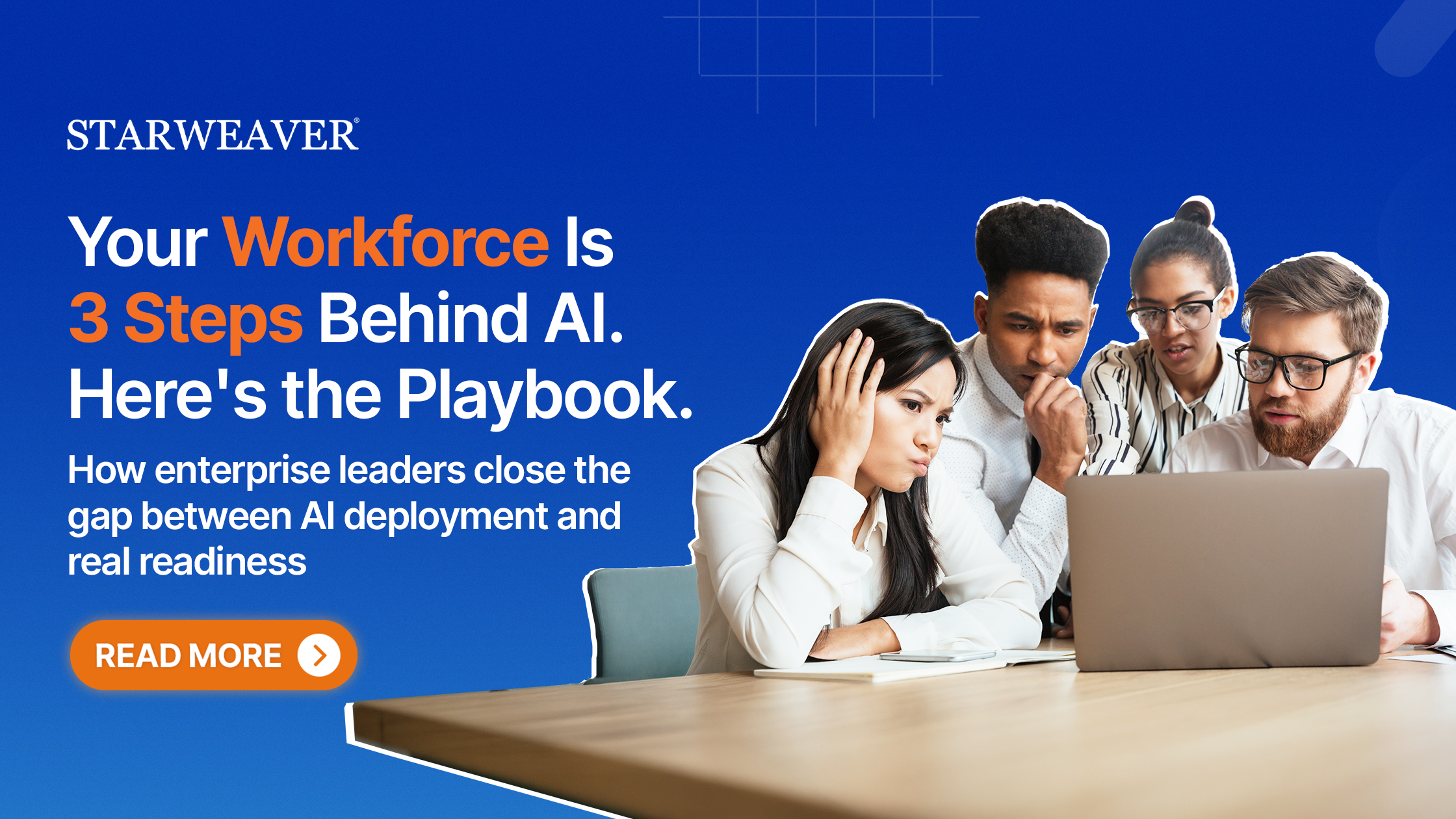
The AI Acceleration Gap: Why Your Workforce Strategy Is Already Behind (And the 3 Steps to Catch Up)
The AI Acceleration Gap: Why Your Workforce Strategy Is Already Behind (And the 3 Steps to Catch Up)
Your organization deployed AI tools six months ago. You announced the rollout with enthusiasm. You sent the all-hands email. You may have even offered training sessions.
And then you looked at the data.
Only 12% of workers report using AI daily in their jobs, despite widespread enterprise deployment of AI tools. The rest have access. They completed the training module. But when faced with real work, they revert to the spreadsheet, the manual process, the way things have always been done.
This is the AI acceleration gap. And it is costing your organization far more than you think.
The Gap Nobody Is Accounting For
Worker access to AI expanded by 50% in a single year, yet fewer than 60% of those workers use AI in their daily workflow, a pattern that remained largely unchanged from the prior year.
What makes this moment different from any previous technology transition is that AI capability is accelerating faster than organizational adaptation. While your team is still building readiness for text-based AI, multimodal AI across video, voice, and simulation is already arriving at enterprise scale. Capabilities turn on overnight. If your workforce mindset and workflows have not fundamentally shifted, you are spending significant budget on tools that deliver pennies in return.
"78% of organizations now report using AI in at least one business function, up from 55% a year prior. Yet only 1% of organizations have achieved what researchers define as AI maturity, where AI is systematically embedded into workflows across the enterprise."
Source: McKinsey & Company, The State of AI 2024
If tools are widely deployed, why is ROI still elusive for most? The answer lies not in the technology, but in the organizational infrastructure around it.
Why Traditional Workforce Strategies Fail in the AI Era
The acceleration gap exists because most organizations treat AI transformation like every other technology rollout. They are not the same.
The traditional playbook:
• Buy the technology
• Announce the rollout
• Offer generic training
• Measure adoption by tool usage
What actually happens:
• Only 10 to 15% of AI pilots reach sustained production
• Only 30% of today's workforce demonstrates full AI readiness
• Teams experiment individually but return to the same workflows they used five years ago
• AI investments generate impressive demos but fail to scale
The problem is not the technology. It is organizational inertia, absence of trust frameworks, poor data readiness, and learning programs that focus on tool familiarity rather than workflow transformation.
The 3 Steps to Close Your AI Acceleration Gap
Step 1: Build Trust-Centric AI Governance Before You Scale
Most organizations deploy AI first and figure out governance later. This approach guarantees failure at scale. The organizations winning at AI implementation do the opposite: they establish trust frameworks, ethical guardrails, and clear accountability structures before widespread rollout.
"Agentic AI is poised for growth with close to three-quarters of companies planning to deploy Agentic AI within two years. Yet only 21% of those companies report having a mature model for agent governance."
Source: Deloitte, State of AI in the Enterprise 2026
This gap between ambition and governance is where most transformation initiatives break down. Speed of deployment without a trust architecture creates resistance, errors, and ultimately abandonment.
What this looks like in practice:
Define clear use cases first. Do not deploy AI everywhere at once. Identify two to three high-value workflows where AI can deliver measurable results, such as employee onboarding, compliance training, or skills gap analysis, and prove value there before scaling.
Establish human-in-the-loop protocols. Most AI training focuses on general literacy or basic tool overviews, but this is rarely concrete enough to change how people actually work. Build review checkpoints where subject-matter experts validate AI outputs before they enter production workflows.
Create transparent AI decision frameworks. When an AI system recommends a learning path, flags a skill gap, or automates a task, employees need to understand why. Explainability builds trust. Opacity builds resistance.
Step 2: Redesign Work, Not Just Training Programs
The single biggest reason AI training fails is that it treats AI as an add-on skill rather than a fundamental redesign of how work gets done.
Employees who cannot see a direct line between AI skills and their own career trajectory will treat upskilling as extra work with no payoff. The data on what this costs, in both compensation and competitive positioning, should make this a strategic priority.
"Skills sought by employers are changing 66% faster in jobs most exposed to AI. Workers in AI-exposed roles command an average 56% wage premium over comparable roles that do not require AI skills."
Source: PwC, 2025 Global AI Jobs Barometer
Redesigning roles around AI changes the calculus for employees. When AI mastery is visibly linked to career growth and earning potential, learning becomes self-motivated rather than mandated.
What this looks like in practice:
Job redesign workshops. Bring together employees, managers, and AI specialists to map current workflows and identify where AI can eliminate friction, augment decision-making, or unlock entirely new capabilities. Efficiency is one goal. Reimagining what is possible is the larger opportunity.
Skills-based career pathways. Make the connection between AI capability, career growth, and compensation explicit. When employees can see that building AI skills moves them forward, learning becomes a priority rather than an obligation.
Embed learning in the flow of work. The most effective AI training does not happen in a module or a classroom. It happens when an employee encounters a real challenge, receives AI-augmented coaching in the moment, and immediately applies what they learned. Learning must be close to the point of need to transfer into performance.
Step 3: Measure Readiness, Not Just Adoption
Workforce readiness shows up in a very specific way: demonstrated competence and confidence in real work, not inferred competence based on course completion rates.
Most organizations measure AI success through adoption metrics: how many employees have access, how many completed training, how many log into the tool each month. These are lagging indicators that tell you almost nothing about business impact.
Organizations closing the acceleration gap ask different questions. Can employees apply AI to solve real problems? Do they know when AI adds value and when it does not? Are they demonstrably improving over time?
What this looks like in practice:
Demonstrated competence over completion rates. Instead of tracking who finished the AI training module, track who used AI to reduce time-to-competency in onboarding, improve decision quality in their role, or unlock capabilities they could not access before.
Continuous feedback loops. Build structured reflection into your learning programs. Guided reflection is not an add-on. It is the engine of improvement. When employees can share what worked, what failed, and what they learned from both, fluency and accuracy improve over time.
Business outcome alignment. Connect AI readiness directly to the metrics your business cares about: revenue per employee, customer satisfaction, time-to-market, quality scores, and innovation velocity. If AI adoption is not moving those numbers, the strategy is not working.
The Cost of Waiting
The AI acceleration gap is not closing on its own. Every month of delayed action widens it further.
"If the global workforce were represented by 100 people, 59 are projected to require reskilling or upskilling by 2030. Of those, 11 are unlikely to receive it, which translates to over 120 million workers at medium-term risk of redundancy."
Source: World Economic Forum, Future of Jobs Report 2025
This is not just about job displacement. It is about competitive advantage. The organizations that figure out how to combine technological acceleration with human confidence will define their industries. The ones that do not will spend the next decade playing catch-up.
You have a choice. You can treat AI as another technology rollout, deploy the tools, offer generic training, and watch adoption plateau at 12%. Or you can recognize that this moment demands a fundamentally different approach: one built on trust, work redesign, and readiness measurement that actually matters.
The leaders who get this right will not just survive the AI transformation. They will define it.
Discover how Starweaver powers the learning revolution
Starweaver is transforming how the world learns by powering the content and infrastructure behind leading learning platforms, universities, and enterprises. Our mission is to make world-class education accessible, personalized, and impactful for learners everywhere.
With a global network of 370+ subject-matter experts, proprietary AI-powered content platforms, and proven delivery excellence, Starweaver has created 515+ courses in 18 months (including 28% of all AI courses on Coursera). Our work reaches millions of learners worldwide, from students accessing university programs to professionals upskilling through enterprise academies.
We don't just build courses. We architect the learning experiences (powered by cutting-edge content, expert instruction, and AI-driven personalization) that help individuals and organizations thrive in an AI-driven world.
=========================================================
About Starweaver
Starweaver operates at the strategic intersection of content creators, learning platforms, enterprise organizations, and universities. As a technology-enabled educational tools provider and content engine, we supply the essential infrastructure, data analytics, and AI-powered platforms that enable leading institutions and corporations to produce, distribute, and optimize high-quality digital learning at unprecedented speed and scale.
If you're exploring bespoke educational content solutions for your organization, we'd welcome the opportunity to share insights from our work across industries.
Contact Us to continue the conversation.
Frequently Asked Questions
What is the AI acceleration gap?
The AI acceleration gap is the widening distance between how fast AI technology is evolving and how quickly organizations can adapt their workforce, processes, and culture to use it effectively. While most enterprises have deployed AI tools, the share that have embedded AI systematically across workflows remains very small, with McKinsey research estimating just 1% of organizations have achieved true AI maturity.
Why do most AI training programs fail to close the skills gap?
Most AI training focuses on generic tool overviews rather than redesigning how work actually gets done. Employees complete modules but do not know how to apply AI to their real workflows, so they revert to manual processes. Effective AI readiness requires job redesign, governance infrastructure, and measurement frameworks alongside learning investment.
What is the difference between AI adoption and AI readiness?
AI adoption measures whether employees have access to tools and have completed training. AI readiness measures whether they can apply AI to solve real problems, improve decision quality, and deliver measurable business outcomes. These are not the same thing, and conflating them is one of the most common strategic errors in enterprise AI rollouts.
What should I do first to close my organization's AI acceleration gap?
Start with governance before scaling. Define two to three high-value AI use cases, establish clear accountability frameworks, and create transparent decision protocols. Then redesign work around AI capabilities rather than treating AI as an add-on skill. Measure demonstrated readiness, not just training completion.
How long does it take to close the AI readiness gap at enterprise scale?
Timelines vary by scope. Basic AI literacy can be achieved in one to two weeks with structured programming. Job-specific AI applications typically require four to eight weeks. Closing the gap organization-wide generally requires a phased rollout of three to six months. Organizations with structured, role-specific programs consistently outperform those relying on self-directed learning.
Share this Blog:
Previous
Measuring ROI on AI Learning Initiatives: A CFO-Ready Framework for L&D Leaders
Next
AI Tools Every L&D Team Should Know About (2026 Guide)
Related blogs
What 'AI-Ready' Actually Means for Your Workforce in 2026
AI-ready does not mean everyone uses ChatGPT. Here is a clear, practical definition of workforce AI readiness in 2026, and what it actually takes to get there.
June 19, 2026
Read more
How to Create AI Training Content 5x Faster- A Complete Guide
Discover the 5 AI-powered techniques L&D teams use to build enterprise training content 5x faster without sacrificing instructional quality or learner outcomes.
May 29, 2026
Read more
1
