Artificial Intelligence
How to Measure AI Training ROI: A Practical Framework for L&D Leaders
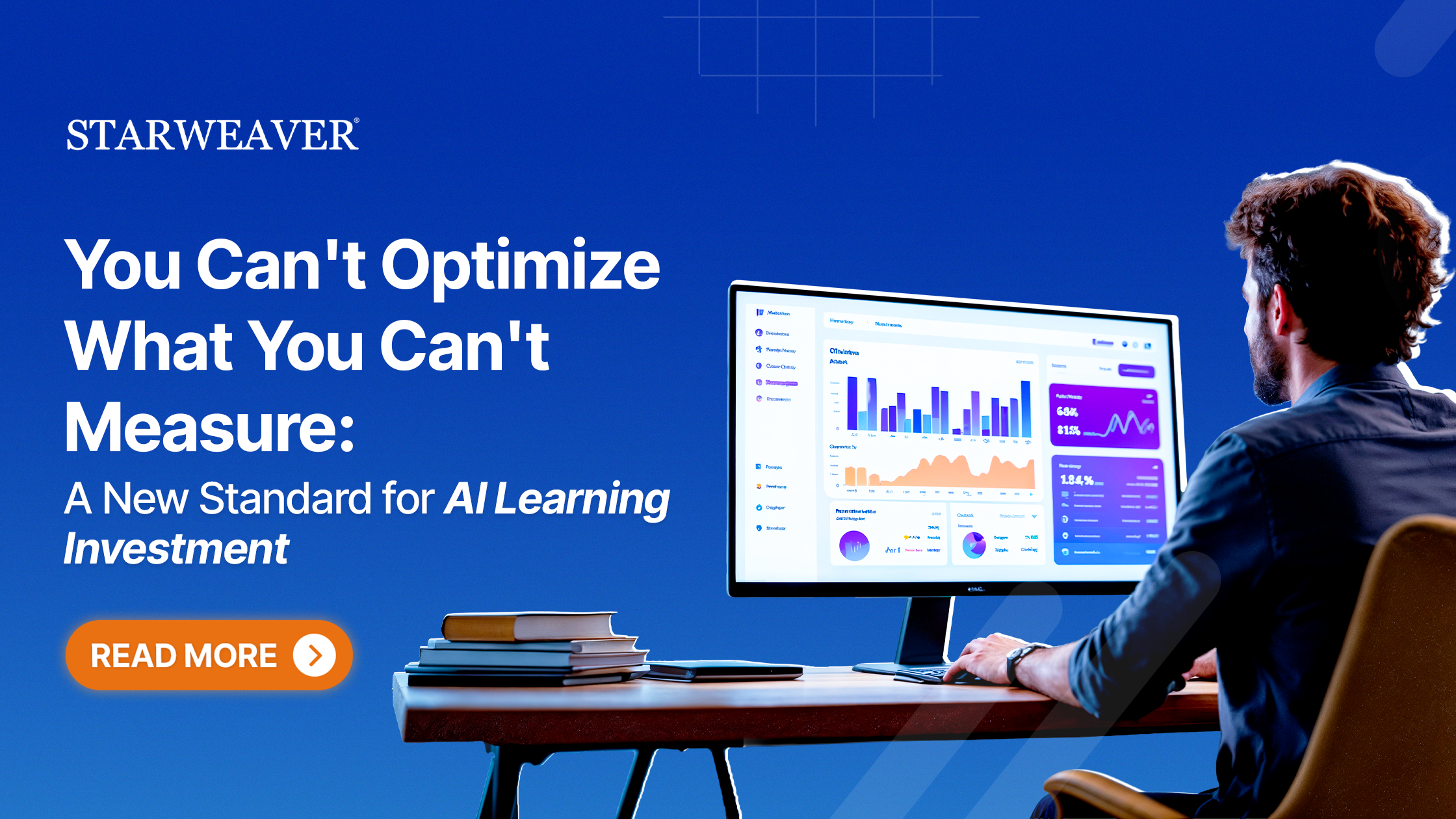
How to Measure AI Training ROI: A Practical Framework for L&D Leaders
Every quarter, CHROs across enterprise organizations face the same uncomfortable moment: a CFO asks for evidence that the millions spent on AI training are actually moving the needle. Completion rates are up. Satisfaction scores look good. Employees are finishing modules. But when pressed for the real question- 'Is this making our workforce more capable with AI?', most L&D functions go quiet. The problem isn't that the training isn't working. It's that no one built the right measurement architecture to prove it. And in today's competitive landscape, where AI capability is becoming a genuine business differentiator, that's a gap that costs real money.
The Measurement Gap at the Heart of Enterprise AI Learning
Most enterprise AI training programs today are operating on faith. Significant budget is being committed, platforms are being licensed, and employees are completing modules at scale. But when a CFO or CEO asks the CHRO a direct question: "Is this working? What are we getting for the investment?" the honest answer in most organizations is that no one really knows.
This is not a funding problem or a content problem. It is a measurement architecture problem. The frameworks most L&D functions use to evaluate training effectiveness were not designed for AI upskilling, and retrofitting completion rates and satisfaction scores onto a program designed to change how people work with AI produces data that is technically accurate and strategically useless.
For CHROs who are accountable for both workforce capability and budget justification, building a credible AI training ROI measurement framework is no longer optional. It is foundational to sustaining organizational commitment to AI workforce readiness over the long term.
Why Traditional L&D Metrics Fall Short for AI Programs
Standard training metrics (completion rates, knowledge assessment scores, learner satisfaction ratings) measure inputs and reactions. They tell you that employees engaged with the program and, in some cases, retained information in a controlled testing environment. What they do not tell you is whether that learning changed anything about how work actually gets done.
For conventional skills training, this gap is manageable. For AI upskilling, it is critical. The entire strategic rationale for enterprise AI training programs is productivity improvement, decision quality enhancement, and competitive capability development. None of those outcomes are visible in a completion dashboard.
There is also a compounding problem: AI tools evolve rapidly. A program that was measuring proficiency in a specific tool or workflow six months ago may be measuring a capability that is already partially obsolete. Measurement frameworks for AI learning need to be designed for change, not built around static skill taxonomies.
"Talent skill gaps are the number-one barrier to AI implementation, cited by 46% of business leaders, yet 92% of executives plan to increase AI spending over the next three years." — McKinsey & Company, Superagency in the Workplace, January 2025.
A Four-Level Framework for Measuring AI Training ROI
The following framework adapts proven evaluation logic to the specific demands of enterprise AI learning programs. It is designed to give L&D leaders a defensible, multi-dimensional picture of program effectiveness, one that can be presented credibly to executive stakeholders.
Level 1: Adoption Metrics (Are People Actually Using AI?)
The most immediate and observable indicator that AI training is producing results is behavioral adoption. Are employees using the AI tools the training was designed to support? At what frequency? In which contexts?
Adoption metrics to track include: active usage rates for designated AI tools within target employee populations, task types where AI assistance is being applied, and whether usage is spreading organically beyond trained cohorts. These data points are typically available through enterprise tool analytics and do not require survey-based collection.
Adoption alone is not sufficient evidence of ROI, but its absence is a strong signal that training has not translated into behavior change. An AI training program with high completion rates and low tool adoption rates has a design or change management problem that no amount of additional content will solve.
Level 2: Proficiency Metrics (Are People Using AI Well?)
Adoption without proficiency creates its own risks, including overreliance on AI outputs, failure to apply appropriate human judgment, and quality inconsistency. The second measurement layer assesses whether employees are using AI tools effectively, not just frequently.
Practical proficiency indicators include: output quality assessments on AI-assisted work products, manager-rated evaluations of AI judgment in role-specific scenarios, and performance on applied skill assessments that simulate real work tasks rather than abstract knowledge tests. Structured peer review processes and manager check-ins calibrated to AI skill dimensions can make this measurement tractable even at scale.
This layer is more resource-intensive to build than adoption tracking, but it is where the most strategically important signal lives. Organizations that invest in proficiency measurement gain the ability to identify capability gaps at a role and team level, which makes targeted intervention possible rather than resorting to blanket retraining.
Level 3: Productivity and Quality Metrics (Is Work Getting Better?)
The third level connects AI training investment to the outcomes the business actually cares about. This is where L&D measurement most often breaks down, because the link between training and business outcomes runs through multiple intervening variables and requires longitudinal data to establish credibly.
The approach that works is not trying to attribute business results directly to a training program. It is identifying a small set of leading indicators that are tightly connected to the specific workflows AI training was designed to improve, and tracking those indicators before and after program deployment in a consistent way.
Examples by function: time-to-first-draft for teams using AI writing tools; error rates in AI-assisted data processing workflows; decision cycle time in functions using AI-powered analytics; volume of routine tasks handled without escalation in AI-augmented support roles. These are narrow, specific, and measurable. They are also the kind of data points that make sense to a CFO in a budget conversation.
Level 4: Strategic Capability Metrics (Are We Building the Workforce We Need?)
The fourth level operates on the longest time horizon and addresses the question that should be most important to CHROs: Is this organization developing the AI workforce capability it needs to compete effectively over the next three to five years?
Strategic capability measurement involves periodic benchmarking of AI skill depth across critical roles, tracking the organization's AI skill profile against evolving job market data, and assessing the degree to which AI capability is distributed broadly versus concentrated in a small number of technical specialists.
This measurement layer is necessarily less precise than operational metrics, but it provides the longitudinal view that enables genuine workforce planning. Organizations that invest in this layer are making decisions about AI training strategy based on where their workforce capability actually stands relative to where it needs to be, rather than making decisions based on what was deployed last quarter.
Practical Considerations for Building Your Measurement Infrastructure
Start before the program launches. Baseline measurement is only possible if it precedes training deployment. Collecting adoption, proficiency, and productivity baselines before a program goes live is the difference between being able to demonstrate ROI and being able to only describe activity.
Align metrics to business outcomes early. The most credible L&D measurement frameworks are built in conversation with CFOs and business unit leaders before program design is finalized. When the business defines what "working" looks like in advance, measurement becomes a shared accountability rather than an L&D reporting exercise.
Do not overengineer the data model. Programs that attempt to measure everything measure nothing well. A tightly defined set of indicators at each level (two to three per level) will produce more actionable insight than an exhaustive metrics catalogue that no one has the bandwidth to interpret and act on.
Separate measurement cadence by level. Adoption metrics can be tracked monthly. Proficiency assessments are typically most useful on a quarterly cycle. Productivity and quality indicators require at least one full performance cycle to interpret meaningfully. Strategic capability benchmarking is an annual activity. Conflating these cadences creates noise rather than signal.
The Organizational Case for Getting This Right
The measurement question is ultimately a credibility question. Organizations that can demonstrate the connection between AI training investment and workforce capability outcomes earn sustained executive support for L&D programs. Those that cannot tend to find their budgets reclassified as discretionary at the first sign of financial pressure.
For CHROs, building measurement infrastructure for AI learning programs is not primarily a technical challenge. It is a political one. The function that can speak to the CFO in the language of adoption, productivity, and capability, not completion rates and satisfaction scores, is the function that retains a seat at the table when AI workforce strategy decisions are being made.
That positioning is worth investing in.
==================================================
About Starweaver
Starweaver operates at the strategic intersection of content creators, learning platforms, enterprise organizations, and universities. As a technology-enabled educational tools provider and content engine, we supply the essential infrastructure, data analytics, and AI-powered platforms that enable leading institutions and corporations to produce, distribute, and optimize high-quality digital learning at unprecedented speed and scale.
If you're exploring bespoke educational content solutions for your organization, we'd welcome the opportunity to share insights from our work across industries. Contact Us to continue the conversation.
Share this Blog:
Previous
Why the Best AI Training Programs Are Built by Practitioners, Not Professors
Next
How to Build an AI Training Program in 30 Days: A Step-by-Step Guide for Enterprise L&D Leaders
Related blogs
Artifactization: Turning Authoritative Content Into Personalized Learning
Artifactization breaks authoritative books and courses into reusable content artifacts, then reassembles them into personalized learning journeys. Learn how.
August 3, 2026
Read more
What 'AI-Ready' Actually Means for Your Workforce in 2026
AI-ready does not mean everyone uses ChatGPT. Here is a clear, practical definition of workforce AI readiness in 2026, and what it actually takes to get there.
June 19, 2026
Read more
1
